


What are the closed-circuit rebreathers, and why we would use them?
Rebreathers, not so long ago, were used only by military and perhaps some scientists. Today rebreathers are getting more popular every day. They found their way not only to technical diving but recreational diving too, and there are many recreational SCUBA divers that use rebreathers almost exclusively.
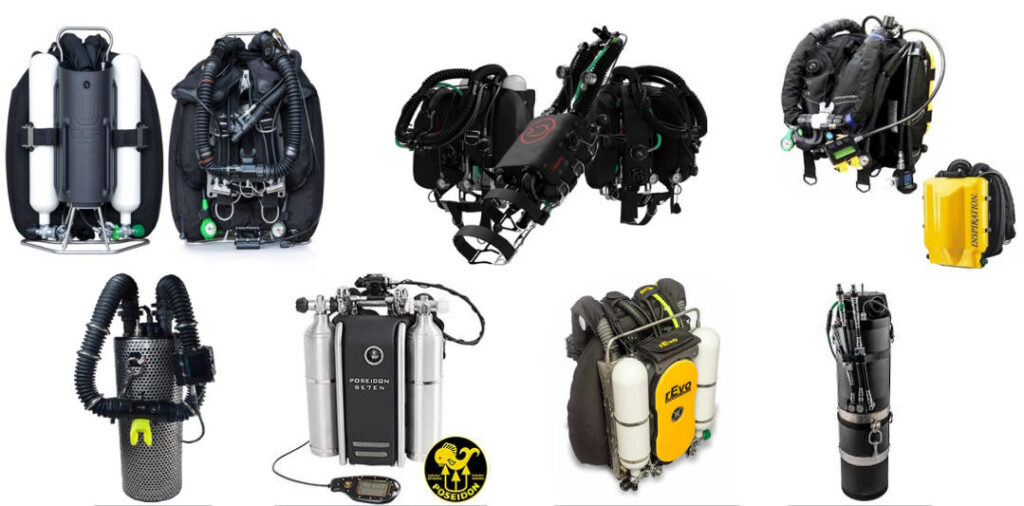
But what are rebreathes?
Rebreathers are underwater life support breathing apparatuses that recycle our breath.
Unlike traditional SCUBA, rebreathers capture our exhaled gas, which gets filtered and reused for new inhalation.
Simply said, rebreather is like breathing in and out of a bag.

But, breathing in and out of a bag eventually will create two problems.
First problem is carbon dioxide (CO2). Our body produce CO2 while metabolizing oxygen, and this CO2 we eliminate by breathing, actually by exhaling. Unless we filtered our exhaled gas, CO2 will build up in the bag, gas will become hypercapnic and we will lose consciousness.
So, if we were to breath in and out of a bag, somehow, we have to eliminate produced CO2.
Second problem is oxygen. With every new breath we are slowly depleting oxygen from the bag, to the point where gas in the bag becomes hypoxic, which means not enough oxygen for our body to function properly. So, unless we replenish oxygen in the bag, we will lose consciousness.
Therefore, if we were to breath in and out of a bag, we have to do two things: remove produced CO2 and replenish oxygen.
This is exactly what rebreathers do. They filter our exhaled gas to remove carbon dioxide. They analyze remaining gas and add oxygen accordingly. Very simple after all.
Obviously, there is not much room for error in performing those functions, so rebreathers have to do them accurately and without error.
Closed circuit rebreathers can be categorized in two main groups: mCCRs and eCCRs. The difference between the two is in rebreather operation.
With mechanical closed-circuit rebreathers (mCCRs) oxygen and diluent are added manually to the loop using so called “MAVs” or manual addition valves, and with electronic closed-circuit rebreathers (eCCRs) oxygen and diluent are added electronically and automatically to the loop. Oxygen is added by electronic solenoid to replace used oxygen to the level previously set by diver, so called “set point”, and diluent is added via ADV or automatic diluent valve, when gas volume in the loop is too small to breath. ADV works as demand valve, similar to the second stage SCUBA regulator.
ECCRs also have mechanical or manual operation as a backup, just in case electronic solenoid fails for some reason, but manual operation could also be used in other situations during normal rebreather operation.
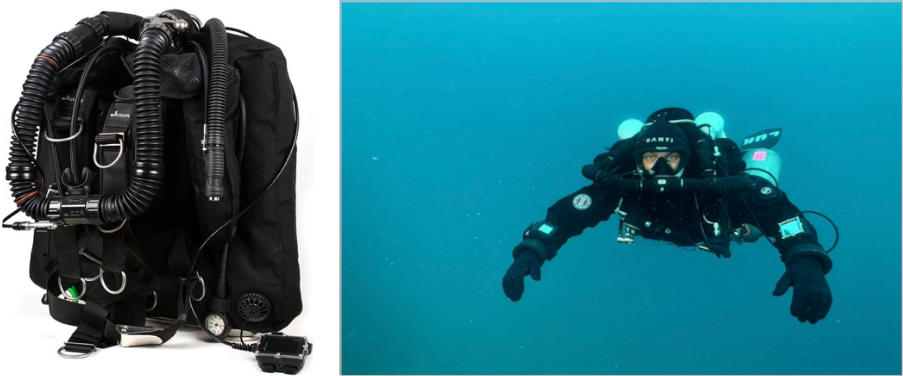
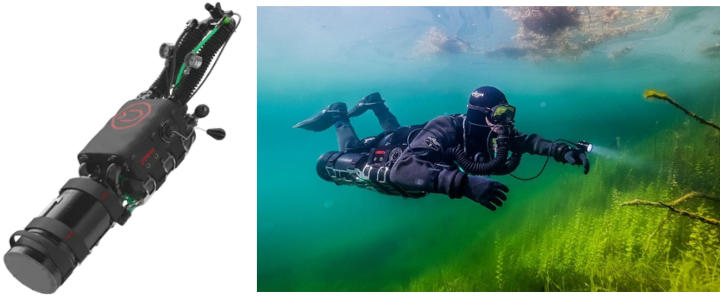
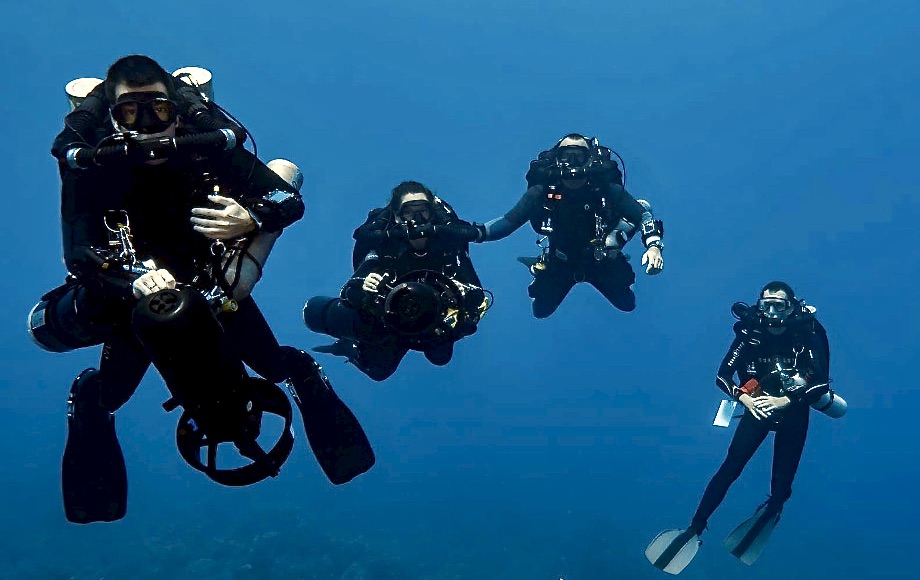
Closed-circuit rebreathers can be further categorized into: Back-mount, chest-mount, and side-mount rebreathers, depending on how rebreather is carried on the body.
Chest-mount rebreather
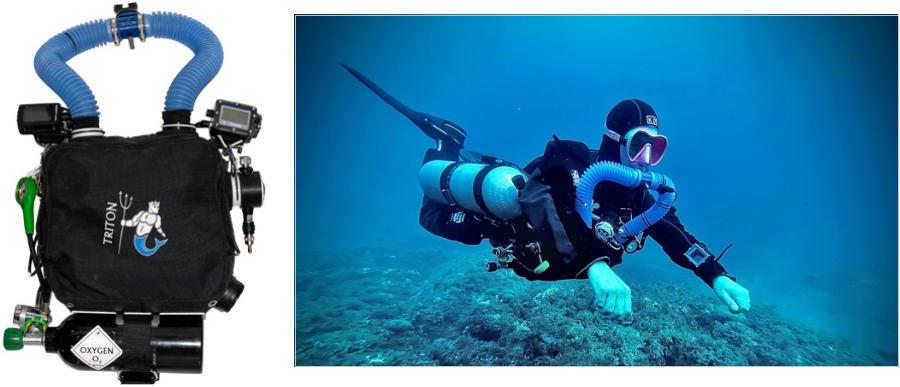
Back-mount rebreather
Side-mount rebreather
In general, all rebreathers have similar basic operation, but still each unit have slight differences. Therefore, it is crucial to seek proper unit specific training and be well familiar, even to the smallest details, with rebreather you are planning on diving.
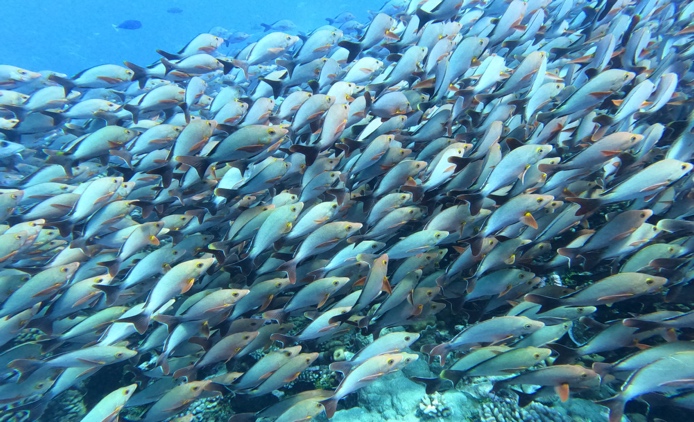
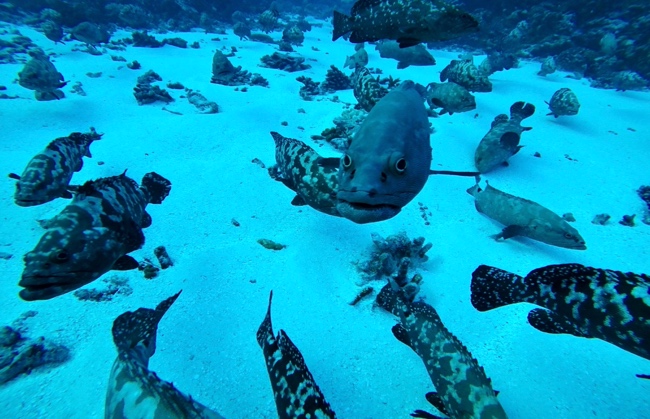
Because exhaled gas circulates around the loop, closed-circuit rebreathers do not produce any bubbles, which makes them completely silent. This is perfect combination for underwater photographers and videographers, for example, as rebreathers allows them to come very close to the aquatic life, not scaring it away.
But this is not the only advantage of rebreather diving. Recycled gas allows rebreather divers
to stay much longer underwater, and at the same time to carry much smaller cylinders compering to open circuit SCUBA.
Due to rebreather’s CO2 scrubber and filtration process, filtered gas is moist and worm, and keeps rebreather divers much wormer during the dive, as compering to open circuit SCUBA.
Also, decompression, if any, is much shorter and quicker when diving on a rebreather, especially on shallow dives. Rebreathers maintain constant partial pressure of oxygen which drastically extends non decompression limits.
But most importantly, and in my opinion the biggest advantage of rebreathers compering to open circuit SCUBA, is time available in case of emergency. Unlike with open circuit SCUBA where in emergency decisions have to be made very quickly, with rebreathers, in most cases, there is more than enough time needed to evaluate situation and make correct decision. Time stress, distance stress and gas stress that we have when diving on open circuit, all that goes away with rebreather diving, which is a big safety aspect, and makes rebreathers actually much safer diving option compering to open circuit SCUBA.
There are also many bailout options with closed circuit rebreathers compering to open circuit SCUBA where in emergency options are very limited.
All this, and much more, makes closed circuit rebreathers very attractive, and not only for technical divers, deep, wreck and cave divers, but also recreational divers too.
How to become a rebreather diver?
Standards are fairly simple and easy. In my opinion too easy.
Minimum requirements to enroll into rebreather course are following:
- 18 years of age,
- be certified as Open water SCUBA diver with 20 logged dives,
- hold Nitrox specialty certificate.
You can completely bypass open circuit technical diving training if you want. But the question is: Should you??
I personally think such pre-requisites are ridiculous, and extremely dangerous.
Fortunately, there are not many open water divers with minimum requirements only that are enrolling onto rebreather courses. Most of CCR instructors will have their personal pre-requirements for divers to be able to join their unit specific courses. I personally do in-water and out of water evaluation of each candidate prior making final decision whether a diver would be suitable for rebreather course.
But in general, a diver without open-circuit technical diving education and training, and without proper mindset, is not going to be able to dive rebreathers safely and without errors that could potentially lead to fatality.
Rebreathers are very technical, require a lot of additional gear too, open circuit bail out etc. Divers have to be able to use all that gear properly, in water and out of the water, including proper preparation, dive planning, bail out planning and execution, constant maintenance and care.
Thoroughness is very important skill for rebreather divers, and technical divers in general. Be calm, take it slowly, follow procedures. In the water and out of the water too. Before the dive, during the dive, and after the dive.
If all mentioned above describes you as person and diver, then you might be good candidate and potentially successful rebreather diver.
Article author: Andrija Lukenda